ICLEI – Local Governments for Sustainability, participated at the 13th session of the Asia-Pacific Forum on Sustainable Development (APFSD) from 24-27 February 2026 in Bangkok, Thailand. Through its engagements, ICLEI reaffirmed its commitment to advancing multilevel climate action and sustainable urban development across the region, and spotlighted the critical role of local governments in delivering on global frameworks.
Advancing People-Centred Urban Data Ecosystems
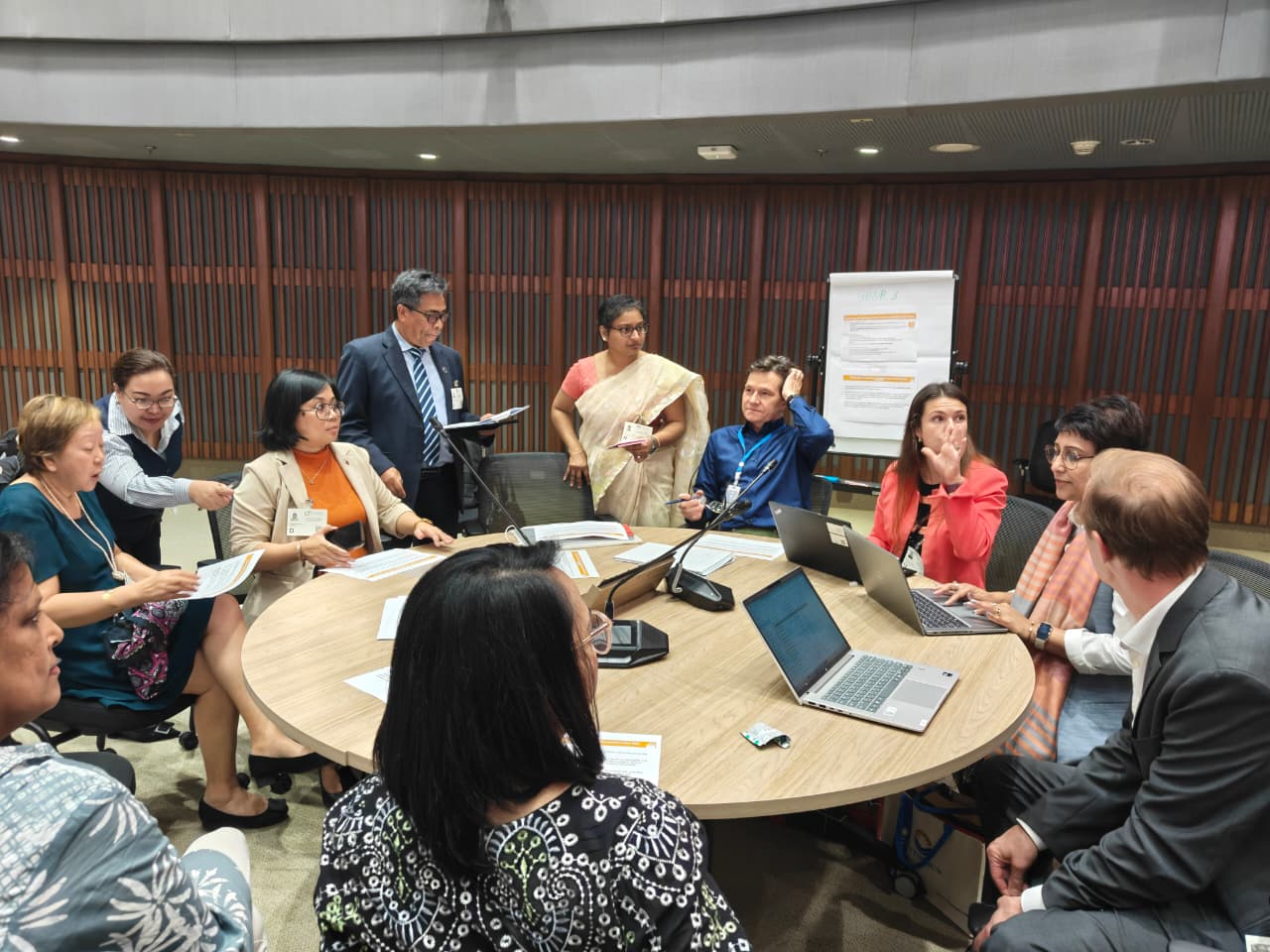
On 25th February, ICLEI participated in a focused roundtable “Harness Digital Transformation to Build Robust, People-Centred Urban Data Ecosystems,” where Ms. Bedoshruti Sadhukhan, Associate Director, ICLEI South Asia, contributed to deliberations on refining priority actions under SDG 11.
The session aimed to review and strengthen the language of proposed priority actions within the SDG 11 Goal Profile, ensuring clear, coherent, implementable, and policy-relevant actions to the SDG that accurately reflect regional priorities and agreed directions. Discussions centered on closing persistent data gaps by strengthening national and subnational data systems, improving the timeliness and quality of disaggregated and geospatial datasets, and incorporating emerging data sources.
Participants stressed the importance of institutionalised multilevel SDG reporting, including through Voluntary Local Reviews (VLR), to enhance accountability and align local development priorities with national strategies. The roundtable explored the deployment of people-centred digital tools such as urban dashboards, digital twins, AI-enabled risk modelling platforms, and integrated national smart city systems. Participants emphasised the need to embed data protection, privacy safeguards, and respect for data rights within digital transformation efforts.
The outcome of the discussion will inform the finalisation of the SDG 11 Goal Profile, ensuring that priority actions are implementation-oriented and reflective of diverse urban contexts across Asia and the Pacific.
Integrating Local and National SDG Reporting
One of the key side events, “Connecting the Dots: Integrating VLRs and VNRs for SDG Reporting,” was convened virtually on 27 March 2026. Led by the Climate & Development Knowledge Network (CDKN) Asia in partnership with ICLEI South Asia, the United Nations Economic and Social Commission for Asia and the Pacific (ESCAP), and the Malé City Council, the session explored pathways to institutionalise VLRs within Voluntary National Reviews (VNRs).
VLRs serve as a powerful mechanism for subnational governments to track and report progress on the 2030 Agenda. Drawing from ICLEI South Asia and ESCAP’s support to three pioneering South Asian cities (Singra, Bangladesh; Dhulikhel, Nepal; Malé, Maldives) in developing South Asia’s first VLRs under the CDKN programme, the session highlighted both the opportunities and challenges local governments face in producing data-driven, community-prioritised reviews.
The panel discussion brought together representatives from the Maldives, Nepal, and Fiji, alongside participants from the CDKN Global Network, ESCAP, and ICLEI South Asia, who called for greater national government support to institutionalise VLR processes, invest in local data systems, and ensure that local priorities meaningfully inform national SDG roadmaps.
The dialogue reinforced the importance of multilevel governance in accelerating SDG localisation and contributing to the global stocktake of progress.
Localising Climate Commitments through NDC Integration
ICLEI South Asia, as the Asia LEDS Partnership Secretariat, co-hosted the virtual side event “From National Commitments to Local Action: Advancing Climate-Resilient Development through NDC Localisation,” with Global Climate Action Partnership (GCAP) and the the NDC Partnership on 27th February. The session focused on the importance of advancing climate-resilient development through sub-national and local integration of the Nationally Determined Contributions (NDCs).
Discussions examined how local leadership, integrated planning, and improved vertical coordination can enhance climate action outcomes. It further highlighted the role of international platforms in enabling collaboration, facilitating peer-learning, and providing technical assistance across various levels of government, with support from development banks in financing the climate ambition.
National government representatives from Bhutan, Fiji, Malaysia, and Nepal, and representatives from GCAP, the NDC Partnership, UNOPS, and ICLEI South Asia shared experiences in aligning national climate policies with local implementation.
Aligned with SDGs 11 (Sustainable Cities and Communities), 13 (Climate Action), and 17 (Partnerships for the Goals), the session underscored the need for participatory urban planning, climate-resilient policies integrated with disaster risk reduction, and scalable financing mechanisms.
At its exhibition stall, ICLEI presented its methodologies, technical tools, and city-level case studies that reflected leadership in advancing SDG localisation, climate-resilient development, and digital innovation for sustainable cities. The stall served as a collaborative space for policymakers and private sector stakeholders to explore practical pathways for climate-responsive urban development.