Climate-induced heat stress is one of the most pressing challenges confronting cities today. Rapid urbanisation, dense built-up areas, and declining green cover are intensifying the Urban Heat Island (UHI) effect, increasing public health risks, reducing economic productivity, and exacerbating inequities.
Tamil Nadu has emerged as a national frontrunner in heat mitigation. It is the first state in India to notify heatwaves as a state-specific disaster and to adopt a comprehensive state-level heat mitigation strategy built on health and well-being, sustainable economic productivity, and cooling solutions. This leadership is further strengthened by the establishment of the Heat Resilience Center — a first-of-its-kind state-level nodal institution supporting city and district heat action planning through evidence generation, policy development, technical capacity building, and project development.
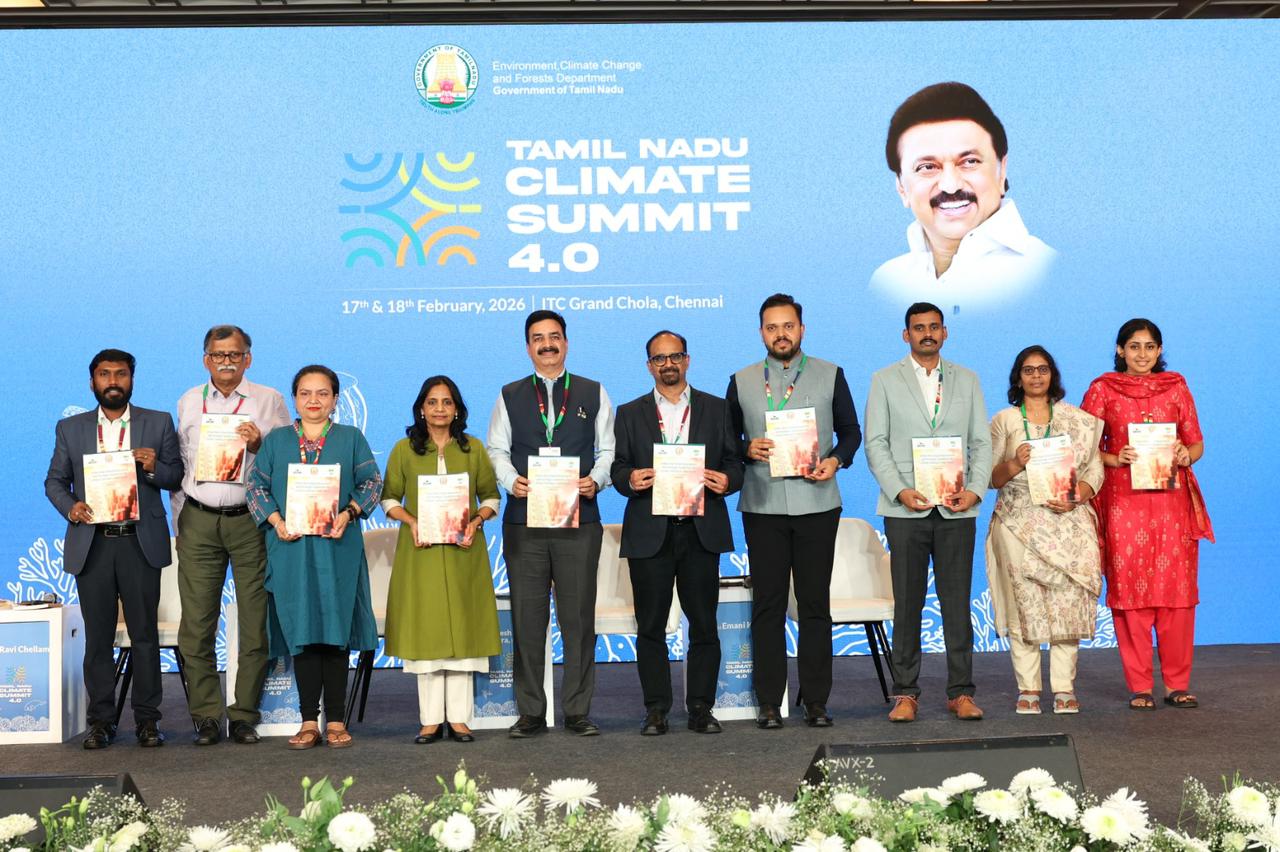
Against this backdrop, the Urban Heat Island Assessment and Strategic Guidelines for Urban Cooling in Tamil Nadu, prepared by Tamil Nadu Green Climate Company with technical support from ICLEI South Asia, was launched at the Tamil Nadu Climate Summit 4.0. The assessment represents a major step toward institutionalising urban cooling as a core development priority. It introduces the first ward-level heat risk index assessment in Tamil Nadu, covering the cities of Chennai, Coimbatore, Tirunelveli, and Tiruchirappalli.
Using the Intergovernmental Panel on Climate Change’s (IPCC) Hazard, Exposure and Vulnerability framework, the report identifies high heat risk wards for each city, overlaying factors such as built-up index, vegetation, access to parks, healthcare infrastructure, proportions of older and younger populations, presence of low-income groups, access to road network, etc. Based on these insights, the report also provides localised urban cooling strategies such as urban greening, heat-resilient infrastructure, and improved public amenities that can significantly reduce heat stress and enhance climate resilience for each city.
Key findings under the Assessment
The assessment reveals distinct spatial patterns in urban heat concentration. Dump yards, landfills, industrial clusters, markets and vacant land show high heat concentration due to sparse vegetation and high built-up density. The findings underscore the need for landfill bioremediation, equitable urban greening, industrial cooling retrofits, and structured blue-green redevelopment of underutilised land. It also highlights the need to prioritise urban cooling interventions in wards with low-income neighbourhoods, which were found to face high heat risk.
The report integrates city level insights with state level urban cooling recommendations, advancing an integrated, systems-based approach linking greening, transport, water management, infrastructure, and community engagement. To operationalise this vision, it proposes a State-Level Cooling Action Plan (SCAP), city-specific Urban Cooling Plans, and institutional mechanisms such as a dedicated Urban Cooling Authority supported by Local Implementation Units, that provide a clear pathway for institutionalising urban cooling in the state. The study provides a scalable, replicable framework for advancing city Heat Action Plans and ward-level urban cooling interventions across Tamil Nadu.
By embedding urban cooling within state planning and governance systems, Tamil Nadu has the opportunity to set a benchmark for heat mitigation that integrates environmental sustainability with public health and economic productivity. ICLEI South Asia will continue to support the state in advancing actionable, data driven solutions for heat mitigation and climate action.
Photo caption: From (L-R)
Dr. P. Thirumurugan, Biodiversity & Wetlands Restoration Expert, ICLEI South Asia; Thiru. Ravi Chellam, CEO, Metastring Foundation; Dr. Monalisa Sen, Associate Director, ICLEI South Asia; Tmt. Supriya Sahu, Additional Chief Secretary to Government, Environment, Climate Change & Forests Department; Thiru. Rakesh Kumar Dogra, Principal Chief Conservator of Forests and Chief Wildlife Warden; Emani Kumar, Executive Director, ICLEI South Asia; Thiru. Rahul Nadh A R, Managing Director/Chief Mission Director, Tamil Nadu Climate Change Mission; Thiru. Jagdish Bakan, CEO, Tamil Nadu Green Climate Company; Dr. Radha Priya P, Manager, Tamil Nadu Operations (Energy & Climate), ICLEI South Asia; Ramya MA, Senior Project Officer (Energy & Climate), ICLEI South Asia