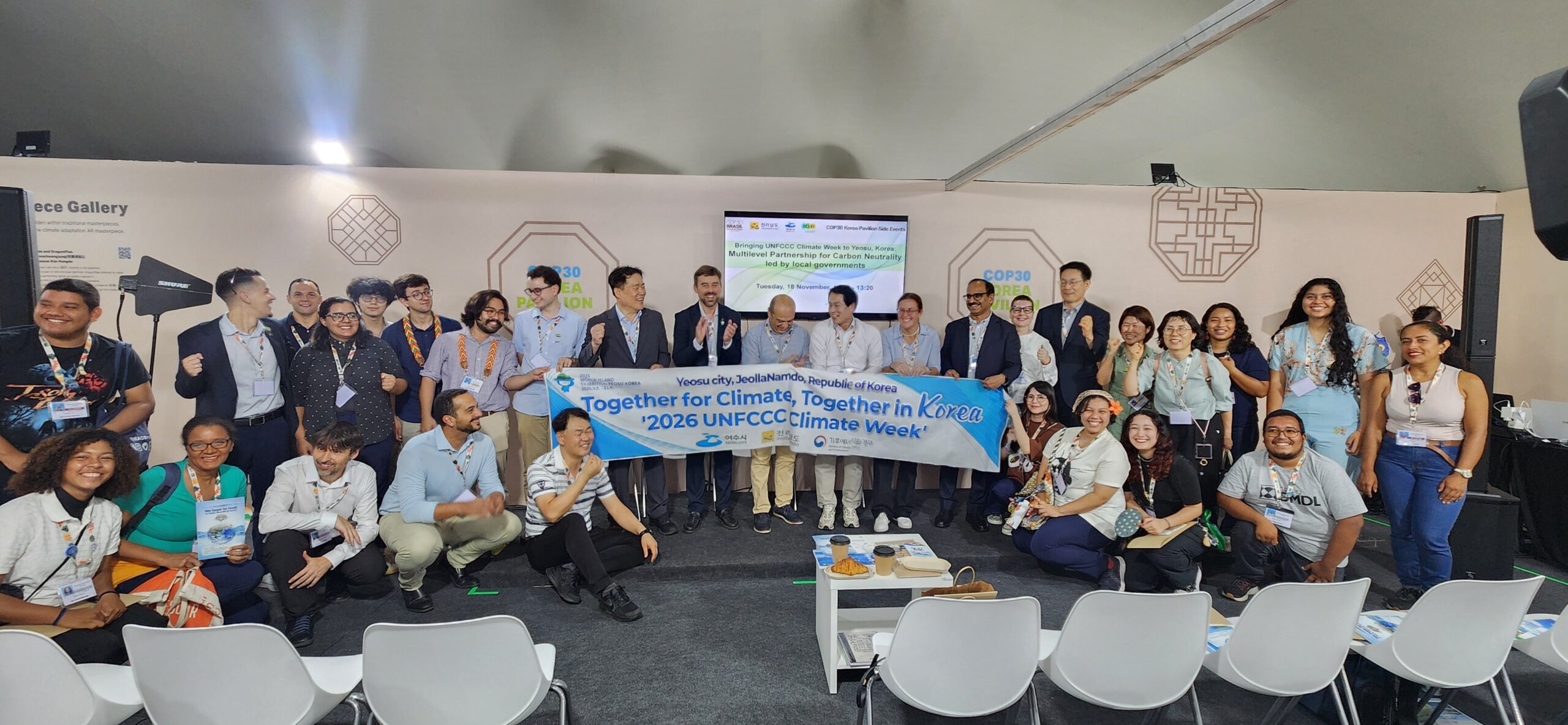
As global attention shifts from climate ambitions to implementation, accelerating the operationalisation of intergovernmental decisions and building momentum for COP31 by facilitating targeted inputs to upcoming meetings, have now become even more critical.
In this effort, the 2026 UNFCCC Climate Week / Climate Week 3 was held alongside the Korea Green Transformation (K-GX) International Week in Yoesu, the Republic of Korea, from 21 to 25 April 2026. Bringing together over 1,000 participants, it included a week-long, structured yet flexible space for high-impact dialogues, capacity-building, and innovative solutions, as well as a targeted two-day Implementation Forum to drive urgent, inclusive, and sustainable climate action.
The event consisted of several UNFCCC-mandated events, covering key topics such as NDC implementation, clean energy transition, Article 6, Loss & Damage, multilevel governance, AI, Indigenous Peoples and local communities, among others. The Implementation Forum, particularly focused on connecting climate ambition with on-ground implementation, and was framed around the Global Stocktake (GST) through the six axes of the Global Climate Action Agenda established at COP 30.
ICLEI South Asia, as a focal point for the Local Governments and Municipal Authorities constituency for UNFCCC and COP processes, participated in two sessions of the Implementation Forum of Climate Week 3 on how local action and finance drive climate delivery.
During the session, “From Local Action to Global Impact: How Subnational and Local Governments Drive Just and Inclusive Climate Ambition and Implementation through Action for Climate Empowerment,” Emani Kumar, Deputy Secretary General, ICLEI and Executive Director, ICLEI South Asia, spoke on ICLEI’s Town Hall COPs, a city-led and transformation-oriented climate dialogue which directly links global climate commitments to local realities. As a practical model led by communities, it also brings together all six elements of Action for Climate Empowerment (ACE) into a single operational platform and showcases how Town Hall COPs can move ACE from principle to practice by:
- Enhancing Climate Change Education and Public Awareness: Town Hall COPs help make NDCs and climate targets clearer and more relevant to people by connecting them to daily issues like health, jobs, affordability, and justice.
- Training and Capacity Building: The platform supports peer learning, knowledge sharing, and interactive discussions between cities, regions, governments, practitioners, and communities, thereby strengthening stakeholders’ ability to move from intent to execution.
- Public Participation: More than 13,000 residents attended 51 Town Hall COPs in 25 countries, working with decision-makers to develop solutions and new policies or plans.
- Public Access to Information: A key part of Town Hall COPs is providing open access to climate information. Communities can find local climate data, plans, and updates, making national commitments, such as NDCs, available to everyone.
- International Cooperation: Town Hall COPs are included in the LGMA COP30 Position Compendium and featured at the COP30 Cities and Regions Hub. This helps countries learn from each other and share best practices.
Notably, Town Hall COPs underpin all six components of ACE through their multilevel governance structure. It successfully connected local, subnational, and national governments at 42 of 51 Town Hall COPs held in 2025. Countries like South Africa have formally endorsed Town Hall COPs, using them to localise national climate planning and shape NDC inputs, while Kiribati’s and Kuala Lumpur’s COPs led to the Ikakrekebai Declaration and, respectively, considerably influenced national COP30 positions.
In the session “Impact Dialogue: Enabled and Investable – Multilevel Governance for Climate Delivery,” ICLEI South Asia noted that cities do not lack climate ambition but rather in structure, accessibility, and aligned finance.
Emani Kumar addressed the fundamental questions that truly unlock finance for cities and regions:
- How do subnational governments assess the bankability of a climate project?
- How aligned are these approaches to the expectations of investors?
- What finance tools are most realistic in the near term? How can cities/regions engage effectively with investors/asset owners?
He highlighted three key pathways to unlock finance for cities and regions:
- Preparing structured, finance-ready pipelines by providing clarity on costs, timelines, and governance, redefining bankability to consider wider social and economic benefits alongside traditional financial returns, and blending available climate finance resources from local, national and international sources, supported by coordinated multilevel governance.
- Bridging local climate ambition with finance architecture through the creation of enabling frameworks and institutional pathways with support from national governments, development finance institutions, and multilateral banks, acquiring practical and adaptable tools, such as blended finance, guarantees, and aggregated financing models, and strengthening local financial and institutional capacities to build credible pipelines.
- Mitigating information asymmetry and clearly translating climate challenges into viable investment opportunities through structured dialogues and multilevel governance, local governments can engage more effectively with investors. Technical clarity on investment scale, implementation timelines, ownership and governance, risk mitigation, and the revenue model further ensures cities transition from intent to action. He further underscored the importance of aligning local priorities with national frameworks that tie into global finance flows.
With better-prepared pipelines and practical, accessible financial instruments for structured engagement between cities and investors, cities will be ready to act and require support in building systems that enable them to act at the speed and scale the climate crisis demands.