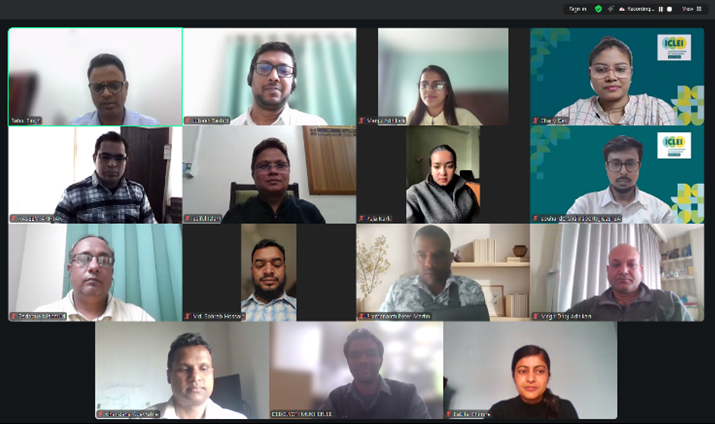
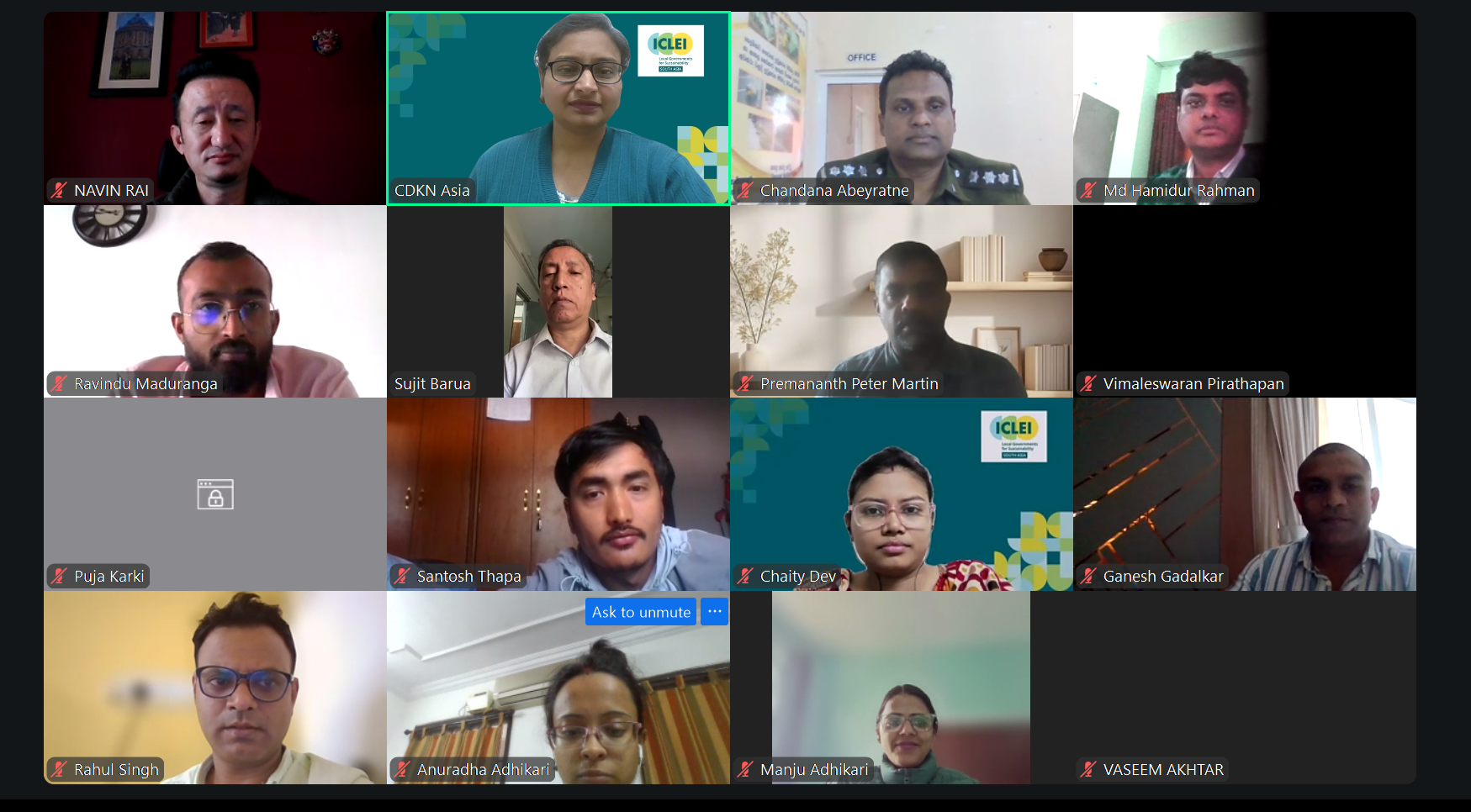
Key highlights from the first series of webinars under the CDKN training and peer learning programme.
Increasing frequency of extreme climate events, coupled with uncontrolled urbanisation, high population and inadequate capacities increase the climate vulnerability of a city. Thus, the urgency to integrate climate resilience into urban planning and management has never been greater, necessitating the strengthening of capacities of city administrations.
In this context, ICLEI South Asia successfully completed its first thematic training series on “Climate Resilience in Cities” through a set of four webinars held in February and March 2026 under the Climate and Development Knowledge Network (CDKN) – Accelerating Inclusive Action” project’s year-long capacity-building initiative. The trainings are designed to strengthen local governments’ ability to address climate change. Implemented under the third phase of the CDKN – Accelerating Inclusive Action project, the programme focuses on three key themes: climate resilience, disaster risk reduction, and sustainable solid waste management. It is supported and funded by the Ministry of Foreign Affairs of the Netherlands and IDRC through the Step Change Initiative. The trainings brought together 18 participants from 17 municipalities across Bangladesh, India, Nepal and Sri Lanka.
The trainings on climate resilience were anchored by the ICLEI South Asia team who guided participants through technical sessions, case studies and collaborative exercises. The team was led by Ms. Bedoshruti Sadhukhan, Associate Director, ICLEI South Asia, along with Mr. Rahul Singh, Senior Manager; Mr. Nikhil Kolsepatil, Programme Coordinator; and Mr. Souhardo Chakraborty, Manager. They featured external speakers, practitioner, and experts including, Ms. Raina Singh, Lead Specialist, Coalition for Disaster Resilient Infrastructure (CDRI); Dr. Rishiraj Dutta, Programme Manager (Nature-based Solutions), Risk Analytic & Climate Services, Asian Disaster Preparedness Centre, Bangkok, and Mr. Ameil Harikishun, Thematic Lead (Finance), South South North, who provided valuable insights and facilitated peer exchanges.
Understanding risks and interpreting urban systems
Participants learnt to look at cities as interconnected systems rather than isolated sectors. Learning about methods such as climate profiling and urban system analysis helped participants reframe familiar challenges like water supply disruptions or drainage failures as outcomes of deeper systemic vulnerabilities. Concepts like urban system fragility enabled city officials to articulate how climate stresses amplify existing weaknesses.
A technical session on greenhouse gas – GHG inventories introduced the participants to the Global Protocol for Community-Scale Greenhouse Gas Inventories (GPC) standards, emission sectors and accounting of emission sources. The method of calculation of GHG emissions was explained in detail, supported by case studies from Dhaka North City Corporation, Bangladesh and Trichy, India.
Making Climate Risks visible and actionable
One of the most practical components of the training was the step-by-step approach to climate risk assessment. By breaking down risk into assessment of hazard, exposure, vulnerability and climate risk, participants gained knowledge of a structured way to interpret complex climate data even in contexts where advanced tools like GIS may not be readily available.
The technical session on vulnerability and climate risk informed that vulnerability assessment, based on sensitivity analysis, helped in identifying the most vulnerable areas in the city. Participants learnt how a climate risk map is generated and that wards falling under extreme and high-risk categories should be prioritised for action by the local authorities. Discussions around adaptive capacity further deepened this understanding.
Participants learnt that while a city’s adaptive capacity is determined by economic, technological, governance, social and ecosystem services that influences its ability to respond to climate risks, it is more importantly about its people and the adaptive capacity of populations and their access to information, resources, and institutional support. This dual lens is critical for regions where social vulnerability often intersects with climate exposure.
Shifting from response to preparedness
Across discussions, a recurring realisation emerged: many cities are still operating in a reactive mode, responding to floods, heatwaves, and other hazards as they occur. The training highlighted the need to shift toward preparedness and long-term resilience planning. By examining common hazards such as flooding, heat stress, and landslides, participants connected climate risks directly to essential urban services such as roads, water systems, and waste management. This linkage reinforced that climate resilience is not a standalone agenda, but one that must be embedded across all sectors of city planning.
Plans to Implementation: Governance and Finance
The final phase of the programme focused on how cities can identify and prioritise interventions based on factors such as resilience potential, feasibility, and possibility of integration into city plan. Involving all stakeholders for effective implementation of climate actions is crucial as it helps to ensure that climate strategies are realistic and not disconnected from city priorities. The session further deliberated on the importance of monitoring and evaluation in helping cities to keep track of implementation of climate actions.
Equally significant was the focus on climate finance. Participants learn about climate financing and how city governments can have access to the existing finance mechanism at the global level. A recurring theme was the need for structured collaboration between local and central government to tap the global finance landscape. Discussion reflected strong interest in climate finance and financing strategies for international funds, especially for countries in the Indian sub-continent. This was particularly relevant as cities increasingly position themselves as key actors in climate action, yet often lack direct access to financial flows. Strengthening this connection is essential for scaling up local initiatives.
Looking Ahead
The webinar series concluded with a participants’ feedback where they appreciated the structure and the content in the programme. While some indicated the need for more time for discussions and clarifications, overall feedback indicated an enriched understanding of baseline assessment, climate risk assessment, climate risk interventions, governance and finance.
This training marks the completion of the first thematic module under the CDKN programme. Upcoming sessions will focus on sustainable solid waste management and disaster risk reduction, delivered through a mix of webinars and in-person engagements. Over the coming months, the sessions will aim to strengthen waste systems, improve circularity, and contribute to disaster management across participating cities.