ICLEI South Asia served as a Network Partner for the BRICS Friendship Cities Conclave 2026, held under India’s BRICS Chairship in Mumbai on 11–12 August, contributing the perspectives and experiences of cities and local governments to the dialogue.
Under the theme “Building for Resilience, Innovation, Cooperation and Sustainability,” the conversations at the Conclave explored critical urban priorities, including the need for integrated, collaborative approaches to urban development that balance economic growth, environmental sustainability, and social equity while building resilience to future risks.
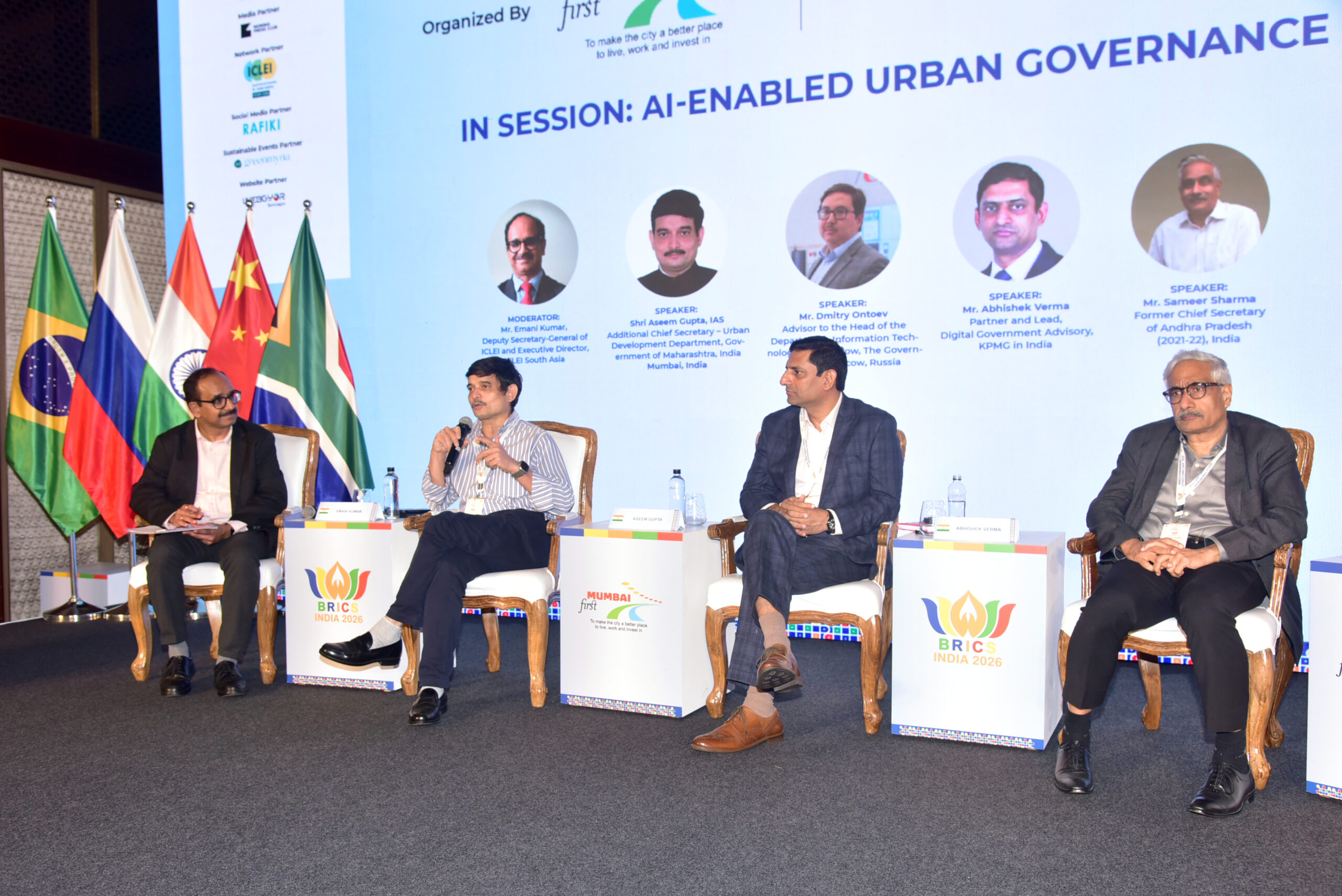
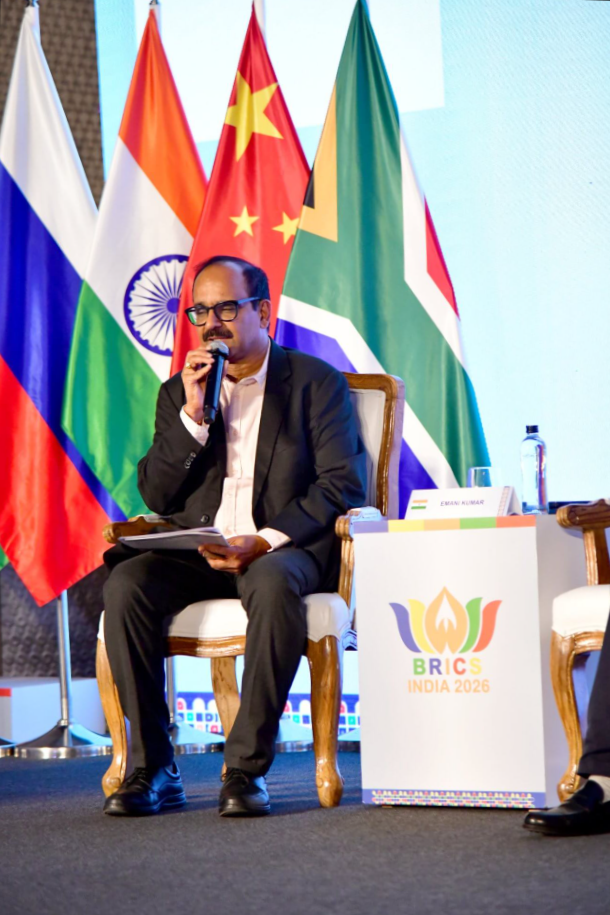
As part of the engagements, ICLEI South Asia contributed to discussions on how cities can translate emerging global priorities into practical, locally relevant action. Emani Kumar, Deputy Secretary General, ICLEI, and Executive Director, ICLEI South Asia, moderated the session “AI-Enabled Urban Governance: Transforming Public Service Delivery and Decision-Making.” It explored the growing role of Artificial Intelligence (AI) in helping cities respond to the scale and complexity of urbanisation.
The panel featured Aseem Gupta, IAS, Additional Chief Secretary, Government of Maharashtra; Dr. Sameer Sharma, Former Chief Secretary of Andhra Pradesh (2021–22); Dmitry Ontoev, Advisor to the Head of the Department, Information Technologies of Moscow, The Government of Moscow, Russia; and Abhishek Verma, Partner and Lead – Digital Government Advisory, KPMG India.
Across its network, ICLEI supports cities in exploring how AI and digital technologies can strengthen evidence-based planning and climate action. The GeoAI Toolkit for Urban Planners, developed by ICLEI South Asia in collaboration with ICLEI Europe and UN-Habitat, is helping municipal bodies map urban expansion, assess environmental risks, and optimise smart-city zoning. As part of its Green Digital Transformation agenda, ICLEI is working in conjunction with the EU Mission on Climate Neutral and Smart Cities on Local Digital Twins and assisting local administrations move beyond simple 3D mapping into data-rich virtual replicas. Through the ICLEI Action Fund, backed by Google.org, more than €10 million has been channelled across Europe and Latin America to support non-profits, academic institutions and civil society organisations using data and technology to advance inclusive community-led climate action.
The discussion highlighted the importance of balancing the opportunities presented by AI with strong governance, public value, and accountability. Key takeaways included:
- While AI has the potential to improve efficiency in urban sector management and service delivery, cities must also exercise caution vis-a-vis public data security, account for environmental cost of data centres and the running costs for AI models.
- It is essential to examine the opportunity costs of investing in AI-enabled systems and governance, particularly in contexts such as India, where public funding does not yet meet the needs of the citizens. AI investments need to demonstrate clear public value rather than compete with fundamental development priorities.
- While AI-driven decision-making in urban governance is likely to become more prevalent, it is essential to preserve the humane angle, particularly for the delivery of social goods and essential services.
With BRICS countries accounting for nearly 45% of the world’s population and over one-third of global GDP, AI-enabled public service delivery presents significant opportunities to strengthen urban governance. AI is increasingly being applied to anticipate service demand, optimise resource allocation, improve infrastructure management and deliver more responsive, citizen-centric services. Its economic potential is also considerable, with AI projected to contribute up to US$15.7 trillion to the global economy by 2030.
The session explored the potential for a BRICS Urban AI Cooperation Platform to facilitate knowledge exchange, capacity building, pilot projects and the sharing of best practices in AI-enabled public service delivery. It reinforced the importance of a collaborative BRICS approach to building responsible, people-centred and future-ready cities, ensuring that digital transformation improves public value while making cities more efficient, responsive, inclusive and resilient.