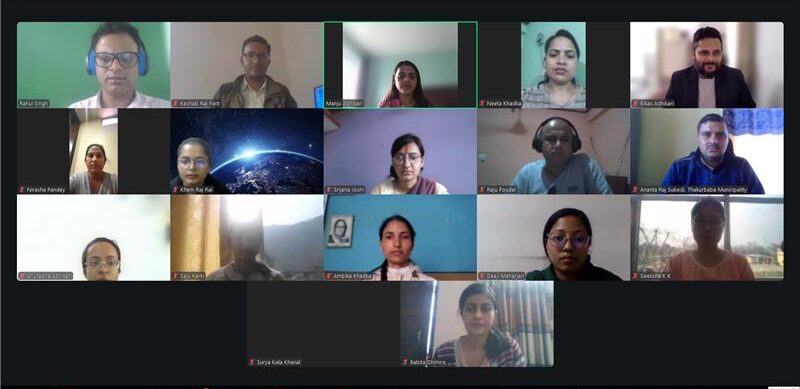
As a part of its ongoing capacity-building series under the Enhancing Local Capacities in Socially Inclusive Resilience in Asia (SIRA) project, ICLEI South Asia conducted a webinar on “Scientific Landfill Development and Safe Closure of Dumping Sites” on 13 March 2026 for cities in Nepal. The SIRA project is funded by UK Aid through the Foreign, Commonwealth and Development Office (FCDO), and the International Development Research Centre (IDRC), Canada, through the Climate Adaptation & REsilience (CLARE) programme. The webinar brought together 36 participants from 15 SIRA cities in Nepal, including municipal officials, environmental experts, and interns, to explore practical and sustainable approaches to solid waste management.
The programme aimed to build participants’ understanding of the relevance of safe dumpsite closure and scientifically managed landfill development, draw practical insights from case studies on dumpsite remediation, and explore the operational modalities required for developing and maintaining such facilities at the municipal level in Nepal.
Mr. Rahul Singh, Senior Manager at ICLEI South Asia, presented the Integrated Solid Waste Management Hierarchy, emphasising that landfill disposal is the least preferred option and Nepal must shift toward circularity — sending only non-recyclable and non-recoverable waste to disposal sites. He highlighted the difficult ground reality of only 5–6 cities operating with proper sanitary landfills. Most waste is dumped openly without segregation, with growing volumes of legacy waste, untreated leachate flowing into rivers, and air pollution from uncontrolled burning. He outlined key challenges, including land constraints, lack of operational guidelines, and serious public health risks, and noted that bioremediation and biomining are the most preferred approaches for addressing legacy waste.
Mr. Pravinjit KB, Managing Director of Eco Paradigm, India, presented practical methodologies for the safe closure of open dumpsites, applicable to developing-country contexts such as Nepal. He began by outlining the environmental and public health risks of open dumpsites, including groundwater contamination, air pollution, greenhouse gas emissions, fire hazards, and disease. He further stressed that safe closure requires a systematic process to reduce long-term environmental damage and restore the site. A central focus of his session was biomining, an effective technique for reducing legacy waste through excavation, mechanical screening, and the separation of recyclables, compostable materials, and inert matter, including key remediation activities such as capping, containment, and byproduct management.
Dr. Eshwar Konkati, Vice President at Re Sustainability Limited, explained the fundamental differences between dumpsites and properly designed landfills, and why the latter is essential for reducing air and water pollution. He introduced the three main types of landfills: industrial/hazardous waste, municipal solid waste, and construction and demolition waste, and explained the key considerations for site selection, landfill design, and construction and environmental monitoring. By highlighting the real-world transformation of the Jawaharnagar dumping site in Hyderabad, India, he offered participants a concrete example of how an open dumpsite can be successfully converted into a scientifically managed facility.
Keshab Raj Pant, Managing Director of Matribhumi Sanrakshan Pvt. Ltd. and Member of the Municipality’s Waste Management Committee, presented the case study of Integrated Solid Waste Management (ISWM) in Godawari Municipality, Attariya, Kailali district. His presentation showcased a functioning public-private partnership model, where the private sector manages daily operations, including door-to-door collection, transportation, waste weighing, segregation, compaction, and fecal sludge management, while the municipality provides oversight and ensures environmental standards are met. Supported by a video of on-ground operations, the case study demonstrated how combining private efficiency with public accountability can deliver effective and reliable waste management services.
Anuradha Adhikari, Deputy Manager of ICLEI South Asia, in her closing remarks, thanked all the participants for joining the webinar.
Pre- and post-session assessments revealed important insights. While initial responses identified key barriers such as limited land availability, financing constraints, and technical capacity gaps, the post-assessment showed a clear improvement in understanding. All participants reported moderate to high levels of knowledge after the session, with none indicating low comprehension. Notably, 47% of participating cities expressed intent to apply the learnings in practice, reflecting the webinar’s effectiveness in driving actionable outcomes.
ICLEI South Asia remains committed to supporting cities across South Asia in strengthening sustainable and climate-resilient waste management systems through continued capacity building, knowledge exchange, and technical guidance. By fostering locally relevant solutions and enabling municipal action, the organisation aims to contribute to cleaner, healthier, and more resilient urban environments.