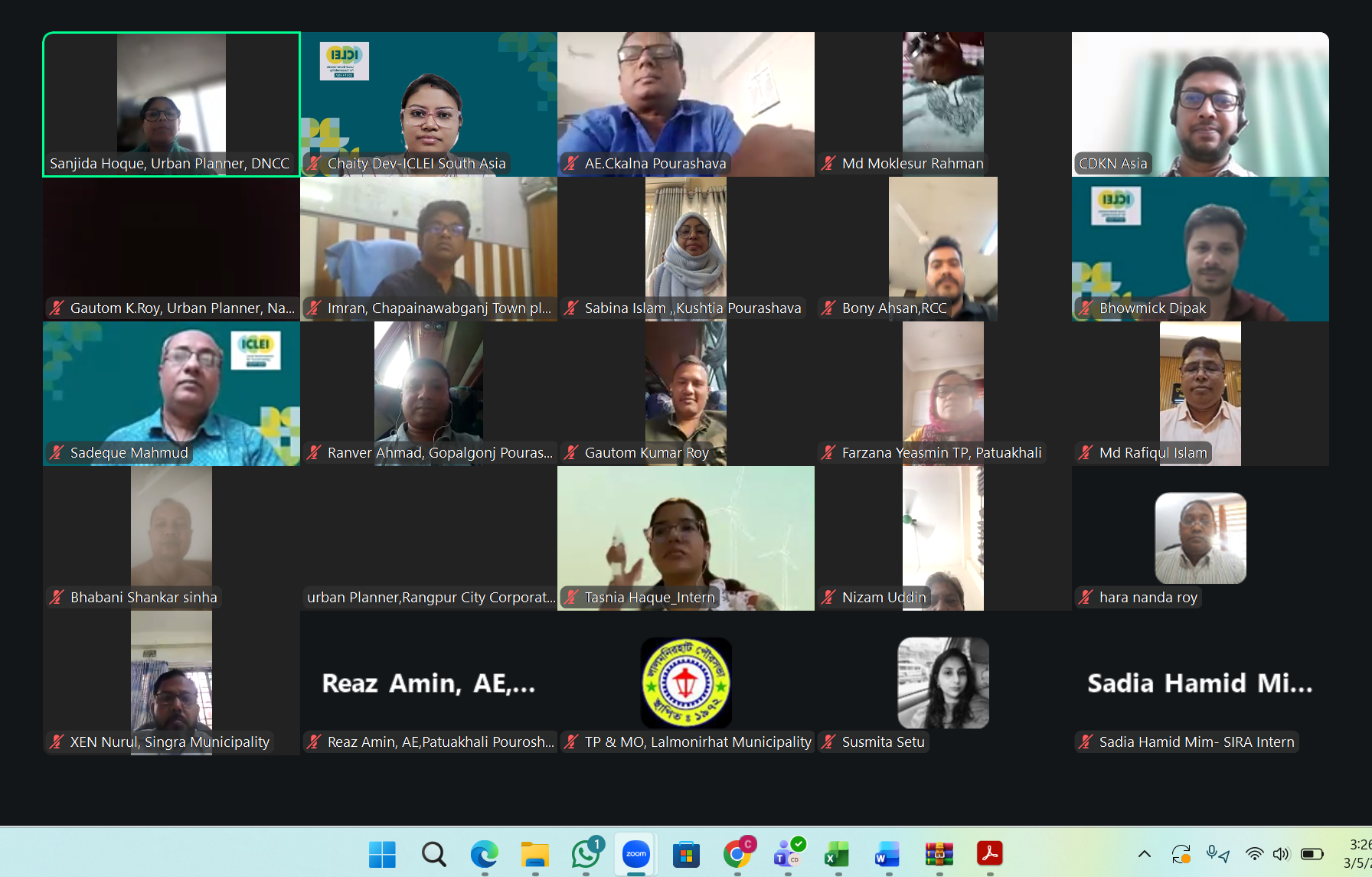
ICLEI South Asia organised an online training on Solid Waste Management and Planning for Municipalities in Bangladesh from 4-5 and 8-9 March 2026, under the Enhancing Local Capacities in Socially Inclusive Resilience in Asia (SIRA) project funded by UK Aid through the Foreign, Commonwealth and Development Office (FCDO), and the International Development Research Centre (IDRC), Canada, under the Climate Adaptation & REsilience (CLARE) programme. The training brought together 48 participants from 16 nominated cities, including municipalities and city corporations, with representation from both men and women. The sessions aimed to strengthen participants’ understanding of solid waste management (SWM) and municipal planning processes.
Through a series of interactive presentations and discussions, the sessions helped participants in building practical knowledge of how cities can manage waste more effectively while moving toward more sustainable, resource-efficient systems.
Understanding the Fundamentals of Waste Management
The programme began with an introduction by Md. Jubaer Rashid, followed by a pre-training assessment. Technical sessions led by Dipak Bhowmick covered the fundamentals of SWM, including waste generation, collection, transport, processing, and disposal.
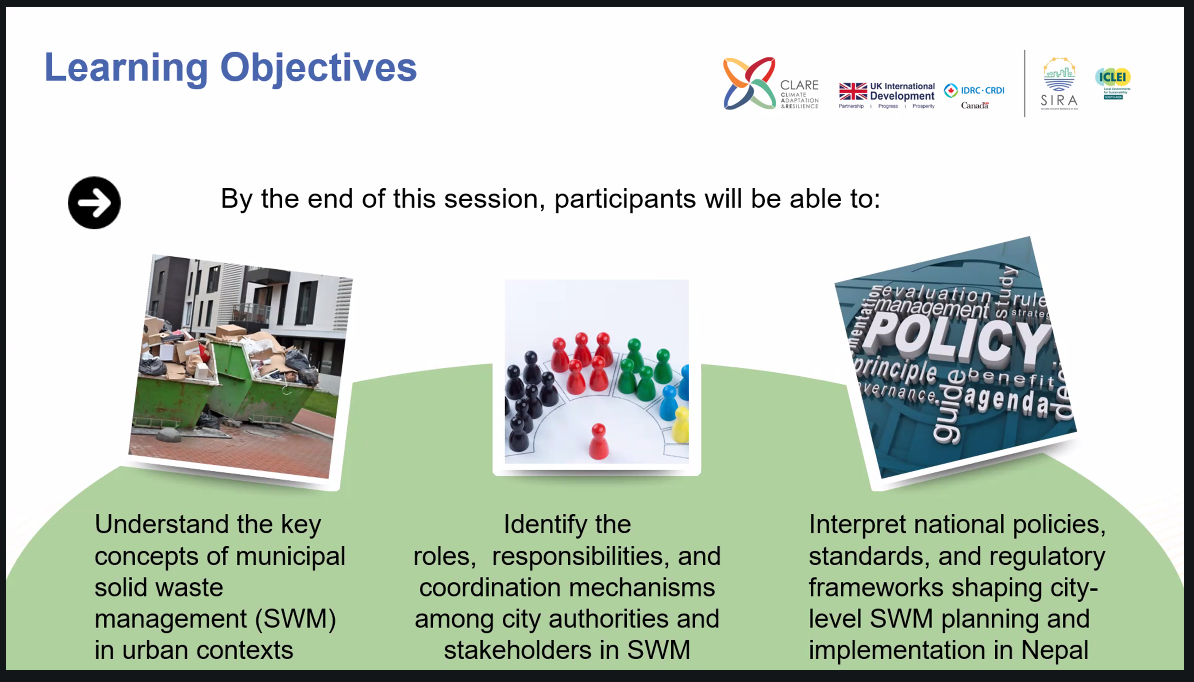
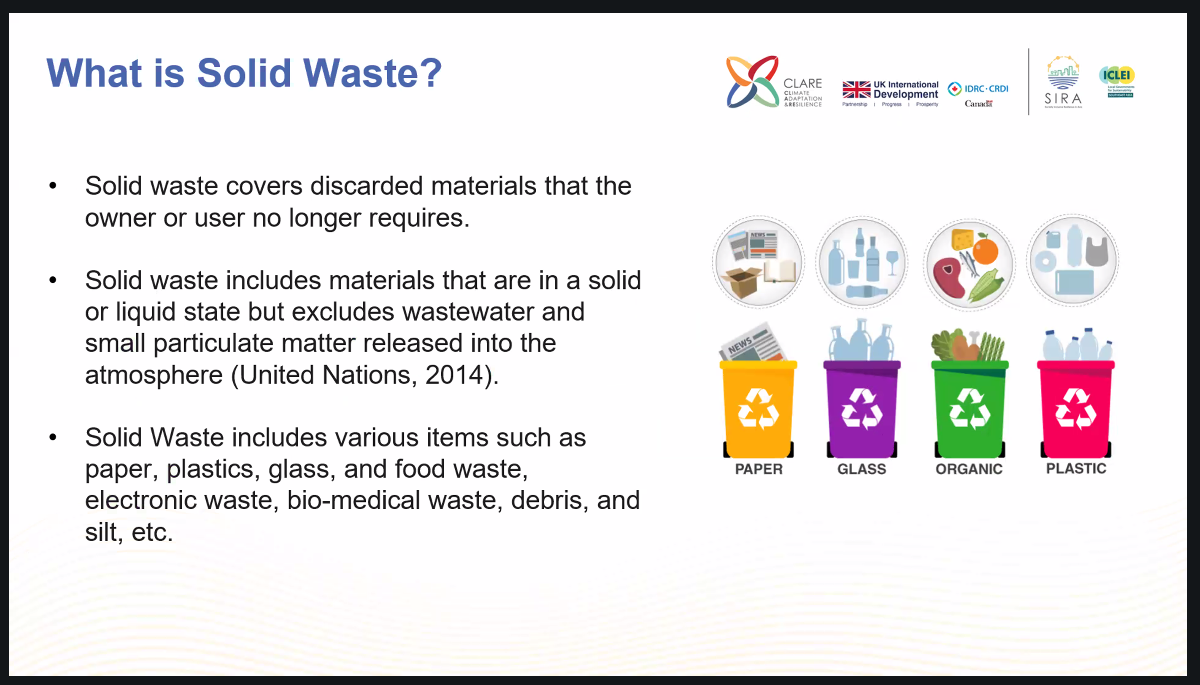
The session introduced the key concepts of SWM in urban contexts, helping participants understand how waste is managed across its full cycle. Participants explored how waste is generated, collected, transported, processed, and eventually disposed of within municipal systems. Discussion examined the current waste management situation in Bangladesh. Participants reflected on common challenges such as limited collection coverage, lack of waste segregation at source, and insufficient treatment facilities.
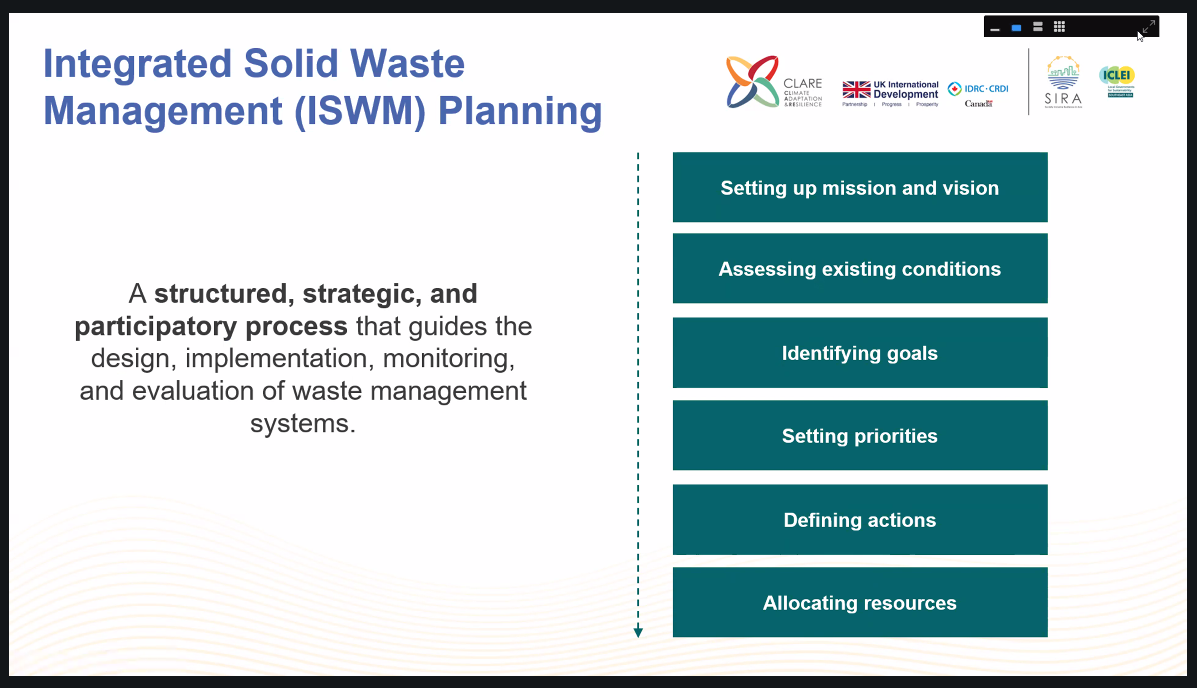
The concept of Integrated Solid Waste Management (ISWM) and the shift toward a circular-economy approach, in which waste is viewed as a resource to be recovered and reused rather than discarded, were introduced.
Planning for Municipal Solid Waste Management
The training focused on how municipalities can develop effective waste management plans. Participants learned about key steps in the planning process, including baseline assessments, stakeholder mapping, gap analysis, and the identification of strategic actions to improve local waste systems. In this context, stakeholder engagement was highlighted as a crucial element of the planning process. Discussions explored emerging challenges in urban waste management and considered possible solutions such as improving waste segregation practices, strengthening infrastructure, and adopting appropriate technologies for waste treatment.
Dr Tariq Bin Yousuf, SWM Specialist, highlighted key practical challenges, including unmanaged waste hotspots, inefficient secondary transfer systems, and ongoing open dumping and burning. He emphasised that segregation should be treated as a system rather than a one-time action, and requires consistent behavioural change. He also suggested integrated solutions combining material recovery facilities (MRFs), composting, and engineered landfills to improve overall system efficiency.
Waste Processing Technologies and Solutions
Participants learnt about waste-processing technologies and the hierarchy of waste-management solutions, and explored different treatment options including composting of organic waste, biomethanation for energy recovery, and material recovery facilities for recyclables. The session introduced scientific landfill management and methods for addressing legacy waste, including bio-mining and remediation. As part of the experience-sharing segment, Ms. Sabina Islam, Assistant Engineer from Kushtia Municipality, presented the city’s composting initiative.
Procurement and Financing for Waste Management
The final session turned to the institutional and financial aspects of implementing municipal waste management projects. The discussion focused on procurement systems and financing mechanisms that support infrastructure development and service delivery. Mr. Aminul Islam, Procurement Specialist at Local Government Engineering Department, explained how public procurement systems in Bangladesh have evolved over time and how structured procurement processes help ensure transparency and accountability in municipal projects. He also discussed how procurement planning, cost estimation, and bid evaluation play important roles in selecting service providers and effectively implementing waste management infrastructure .
The training provided the participants with a clearer understanding of the solid waste management cycle, from planning and stakeholder engagement to waste-processing technologies and project implementation. More importantly, it highlighted the importance of integrated approaches that combine policy frameworks, technical solutions, community participation, and transparent governance systems.
Throughout the sessions, participants shared their experiences and challenges from their respective municipalities, creating a valuable platform for peer learning and exchange. The programme concluded with a post-training assessment and a brief reflection session, where participants shared key takeaways and expressed their appreciation to the organisers and facilitators for the informative and engaging training.
ICLEI South Asia remains committed to supporting cities across Bangladesh in strengthening their solid waste management systems and advancing sustainable urban development. Through continued capacity-building initiatives, technical guidance, and knowledge exchange platforms, the organisation aims to empower local governments to adopt integrated, inclusive, and resource-efficient approaches to waste management.