As extreme heat and air pollution increasingly overlap in India’s cities, children and young people face compounding risks to their health, well-being and everyday lives. Yet, policies and action plans often address these concerns separately, with limited attention to the specific needs and vulnerabilities of children.
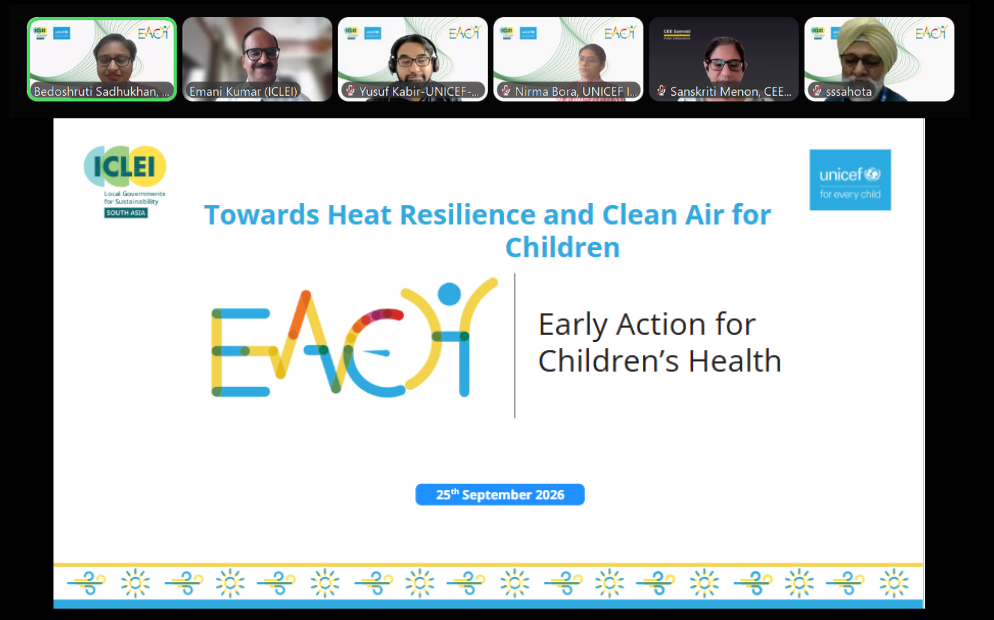
Against this backdrop, ICLEI South Asia, in partnership with UNICEF India, convened the first meeting of the National Partnership Stakeholder Group meeting under the Early Action for Children’s Health (EACH) project on 25 September 2026.
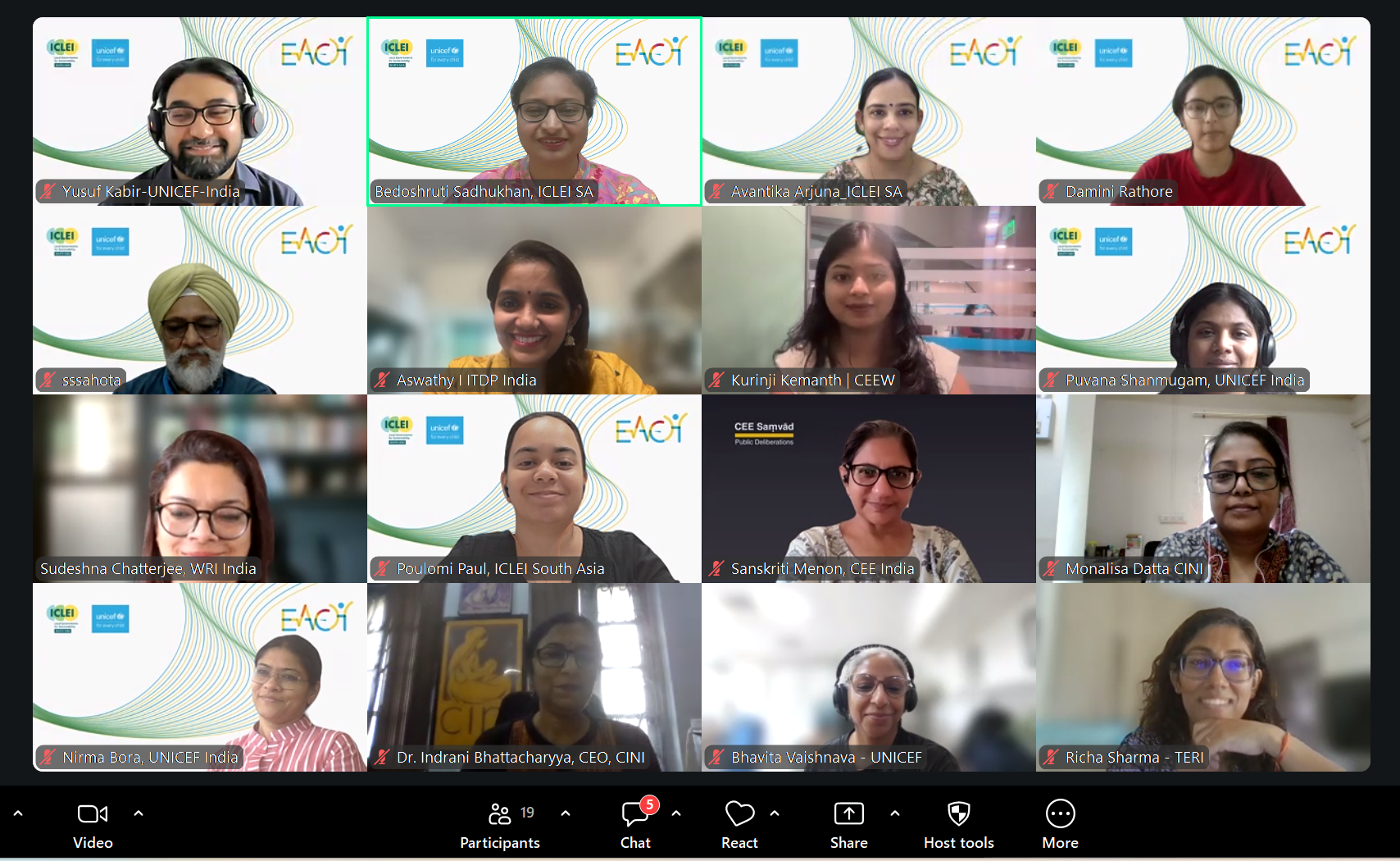
The meeting brought together representatives from ICLEI South Asia, UNICEF India, Centre for Environment Education (CEE), Child in Need Institute (CINI), The Energy and Resources Institute (TERI), World Resources Institute India (WRI India), Institute for Transportation and Development Policy India (ITDP India), Council on Energy, Environment and Water (CEEW), The Urban Catalysts, and Jawaharlal Nehru University (JNU). The session was moderated by Bedoshruti Sadhukhan, Associate Director, ICLEI South Asia.
The discussion highlighted the need to move beyond treating heat and air pollution as standalone, seasonal environmental concerns, and view it as a public health concern, with specific impacts on children and youth.
The policy landscape for child-sensitive heat and air quality measures
Opening the session, Sarbjit Singh Sahota, Chief, Disaster Risk Reduction, UNICEF India, highlighted the importance of early action to ensure continuity of essential services for children and build resilient infrastructure. Emani Kumar, Secretary General, ICLEI and Executive Director, ICLEI South Asia, introduced the EACH project and highlighted child-focused projects supported by ICLEI South Asia, emphasising that national policies need a child and youth lens.
Further, with children accounting for about 39% of India’s population, Yusuf Kabir, Program Specialist Climate and Environment, UNICEF India highlighted how exposure to heatwaves and poor air quality can have consequences across the life cycle of children, and their compounding impact. Avantika Arjuna, Assistant Program Coordinator, ICLEI South Asia presented insights from the project’s initial review of India’s air quality and heat governance frameworks, identifying gaps in policy design, targets and implementation guidance.
From awareness to participation and action
The discussion brought together perspectives from research, think tanks, and urban practice. A key message emerging from the meeting was the importance of moving children and young people from being passive recipients of information to active participants in decision-making. The stakeholders highlighted approaches such as involving children in vulnerability mapping and climate action planning, incorporating their perspectives into youth consultations, and creating opportunities for school and community-level engagement.
Gaps in age-disaggregated data, local-level monitoring, institutional coordination and financing were highlighted. At the city level, limited capacity within urban local governments, fragmented climate and health planning, and the difficulty of translating pilot initiatives into policy continue to constrain sustained action.
The discussants also identified a range of opportunities for stronger action, including child-specific heat thresholds and advisories, improved monitoring around schools and other child-sensitive locations, integrated heat and air quality planning, community cooling hubs, including in rural areas, shaded streets and safer mobility, and better use of data to inform school management and local decision-making.
Building a collaborative agenda
The EACH project aims to examine the compounding impacts of extreme heat and air pollution on children and young people, to advocate for policy changes that respond to their specific needs.
The National Partnership Stakeholder Group for EACH is bringing together diverse expertise and experiences in child- and youth-sensitive heat and air quality planning and action. The first meeting marked an important step towards building a shared agenda that places children’s health, voices and needs at the centre of climate action.