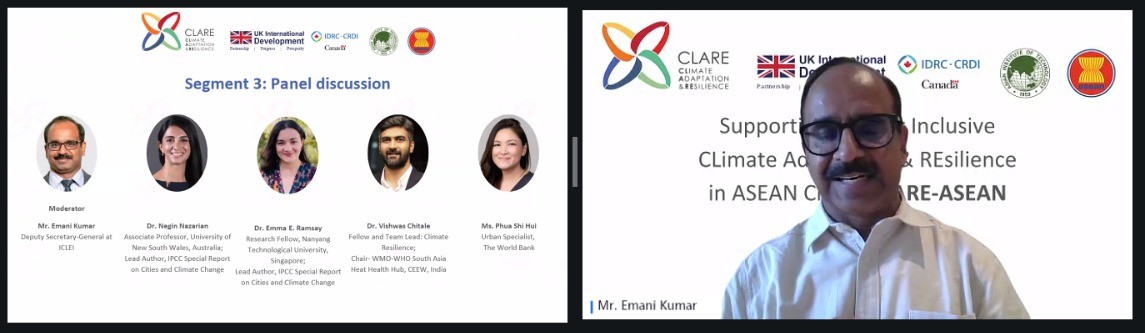
Urban heat is emerging as a critical challenge for cities across Southeast Asia, with rising temperatures, longer heatwaves and increasing impacts on health, livelihoods and vulnerable communities. Against this backdrop, the CLARE–ASEAN Initiative at the Asian Institute of Technology (AIT) convened a regional webinar on “Urban Heat Management for Climate Adaptation and Resilience in ASEAN Cities” on 20 August 2026, bringing together experts and practitioners to discuss evidence, institutional approaches and practical solutions for building urban heat resilience.
Mr Emani Kumar, ICLEI’s Deputy Secretary General, moderated a panel discussion that included Dr. Negin Nazarian (UNSW/IPCC Lead Author), Dr. Emma E. Ramsay (NTU Singapore/IPCC Lead Author), Dr. Vishwas Chitale (CEEW/Chair, WMO-WHO South Asia Heat Health Hub) and Ms. Phua Shi Hui (World Bank Urban Specialist). Guiding the conversation around neighbourhood-level resilience, institutional preparedness, nature-based solutions (NbS), financing, and gender equality and social inclusion (GESI), he emphasised the need to move beyond city-wide strategies towards locally grounded, implementable heat action. Key discussion points that emerged from the panel discussion were:
- Urban heat management approaches should consider micro-climate hotspots, differential vulnerability (outdoor workers, informal settlements, low-income groups), and the need to treat heat as a public health issue, including productivity loss and increasing cooling demand.
- In dense tropical cities, buildings release heat slowly at night, so poorly ventilated homes can stay dangerously hot even after outdoor temperatures fall.
- Solutions to heat resilience extend across multiple agencies, and involve integrating the issue into investment plans and funding for urban projects from pilots to city-wide programmes. Bangkok Metropolitan Administration (BMA) working group on heat was highlighted as a best practice.
- Heat early-warning systems tied to health and heat index, rehydration points at transit stops, shaded bus stops for gig workers, and use of current municipal resources rather than new capital-intensive projects.
- The panel also discussed the need for heat risk assessment for critical infrastructure (hospitals, fire services), the transition from pilots to broader investment pipelines through PPPs, scheme convergence, and the scaling of planning frameworks, data and community engagement processes across ASEAN cities.
ICLEI South Asia is working on heat action planning through IDRC’s CLARE opportunity fund, such as inclusive local adaptation in Nepal, nature-based canal restoration in Kochi, gender-equitable street vending in Rajkot, forest management policy in Nepal, and environmental guardianship in Fulhavalhu, Maldives.The discussion further highlighted the importance of nature-based solutions, community knowledge and inclusive governance in long-term resilience building.
The webinar reinforced the message of building heat-resilient cities through an integrated and socially inclusive approach, backed by institutional capacity, evidence and sustained investment. Knowledge exchange across ASEAN cities can play an important role in adapting solutions to local contexts and addressing the urgency of urban heat issues.